
Exploring the Twain 5 – Major issues between East and West

Today I started making a list of the various differences I’ve come across between the Eastern Orthodox and Evangelical theology (I am ignoring the RCC at this point, as it has its own issues, and it’s my blog).   Here’s the list, in quasi-random order:

  1. The interpretation of the phrase “We believe in one holy catholic and apostolic Church” from the Nicene Creed.
  2. Tradition and authority
  3. The acceptance of the “filioque” clause in the Nicene Creed by the RCC and Protestant churches
  4. Views of the Atonement: Christus Victor vs. Substitutionary or Penal theories
  5. Soteriology: Theosis/deification vs. a forensic view of justification
  6. Apophatic vs. Capophatic theology
  7. Mystical v Rational theology
  8. The nature of sin

I quite possibly have left out something important, and reserve the right to add to this list.  Also, there is a bit of overlap in my list.   On some items in the list, I tend to agree with the Orthodox view (3, 4, 8); on others, I disagree (1, 6), and on the rest I either am “agnostic” or would take an inclusive or MOR position.  In the next few posts I will discuss each of these, in probably another quasi-random order.

One Holy Catholic and Apostolic Church

It probably has not occurred to many people that churches who confess the Nicene Creed (including Orthodox, RCC, Lutheran, Anglican and many others) disagree on the meaning of “We believe in one holy catholic and apostolic Church.”  Most of us who were raised Protestant understand this to mean that we believe in the invisible church, inclusive of all believers regardless of denomination.  The Orthodox, however, do not believe in this “invisible” church; to the East, this statement refers to the various churches in the Eastern Orthodox tradition, exclusive of the Roman and Protestant churches.

When this creed was developed in the 4th Century, there was only one church; the Roman church, while divided by language and politics, was still joined to the Eastern church.  So, this was not an issue until the Great Schism of 1054 (if I recall correctly) at which time the Roman church excommunicated the Orthodox, and the Eastern church “wrote off” the RCC.  Both factions laid claim to the Creed, believing that they were the “one” visible church.  When Luther & Co. began the Reformation, the phrase was reinterpreted to refer to the global, “invisible” church.

It is also interesting to note that some Protestant churches disagree with this line of the Nicene Creed (the Orthodox refer to the creed as the “Nicene-Constantinopolitan Creed” as it was finalized in the later Ecumenical Council), as they refuse to accept the Orthodox and RCC churches.  How ironic.

Because the Eastern church believes salvation as flowing from the Church, this has obvious implications in the Eastern view of the Western churches.  While most do not say that there are no non-Orthodox Christians, they will not go so far as to say that salvation is possible outside of the Church.  One really has to better understand the Orthodox view of salvation to understand this issue, but I confess that so far, I don’t have that level of understanding.

If any of my 11 readers has some thoughts on this issue, I’d love to hear them.  I am on a fact-finding mission here, rather than being pedantic.
Posted in Church, Exploring the Twain | Tagged , , , , , , , , , | 15 Comments

Exploring the Twain 4 – Neo-Platonism and Eastern Orthodoxy

In my last post in this series, I promised to examine the neo-Platonist influences in Eastern Orthodoxy.  If I knew then what I knew now – or didn’t know then what I don’t know now, I wouldn’t have made such a promise.  As it turns out, trying to pin this issue down has a number of problems.  While there are a great many sources discussing Augustine’s neo-Platonist orientation, there are very few – that I have found – discussing in any specificity the neo-Platonist influence on the Eastern Church.  And, of the sources I did find, I found a great deal of disagreement.

What I will do in this post is lay out a sketch of the issue as I currently understand it, which if nothing else will show what I don’t know, hopefully inviting input from others.

First, neo-Platonism refers to the 3rd century revival of Platonism, mainly as taught by Plotinus, who apparently was trying to clarify some misunderstood elements of Plato’s writings.  Just as contemporary philosophy has impacted Western theology, neo-Platonism also had an influence on some of the Greek-speaking early theologians, as well as on such Western theologians as Augustine.

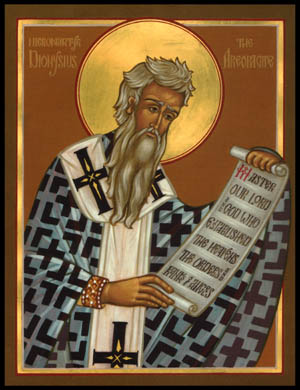
Many of the Church Fathers showed signs of neo-Platonist thinking, including Gregory of Nyssa, Origen, Maximus the Confessor, and the most-often connected with neo-Platonism, the fellow known as Pseudo-Dionysius, also known for developing the Eastern Church’s Apophatic approach to theology.

The Orthodox, however, reject the notion that any Platonist or neo-Platonist philosophy made its way into their theology. Rather, they say that Gregory, et al., only used neo-Platonist terms to explain what the Church always believed. For example, Gregory of Nyssa used neo-Platonic language to argue for the infinity of God (contrary to the teaching of Origen, who held to the earlier Platonic concept that God was finite, as He could be known).  (The concept of the infinity of God is a key element in the later development of Apophaticism.)

While there are certainly neo-Platonic concepts used in the Eastern church, I can’t say at this time whether the church was influenced by the neo-Platonists, or whether they are correct in that they only used those concepts to convey a pre-existing theology.

This Eastern way of looking at the development of theology – that the formation of Orthodox theology and Tradition only clarified the Apostolic faith that the church always believed – is if nothing else, convenient.  It also appears somewhat circular, based on the belief that the Orthodox Church is the one and only true church and the belief that God is preserving in the church the Apostolic faith.  It seems to assume that anything the Orthodox Church believes is necessarily Apostolic and correct, even though there have been a number of disagreements over the years.

The belief that the Eastern Church is the one true church also appears somewhat circular; they have the Apostolic faith because they are the one true church, and they are the one true church because they have preserved the Apostolic faith.  Of course, if they are correct, they don’t need a better argument.

While I am obviously impressed by much in the Eastern traditions, there are elements of Orthodoxy that I have a hard time with, which I will try to outline in coming posts.

Posted in Church, Exploring the Twain | Tagged , , , | 3 Comments

Status update

This is just a short post to let my faithful readers know I haven’t lost interest in the blog or dropped off the face of the earth.   The last couple of weeks have been consumed with home improvement projects and Christmas. While I fully intended to post my next in the “Exploring the Twain” series during the holidays, I expect it will be a few days before that gets done.

Another excuse is that I was given G.K. Chesterton’s Orthodoxy for Christmas, and it has more or less preempted my other reading plans.  Why haven’t I read this book before?  Chesterton is amazing… my New Year’s resolution will probably be to read more of him.  So, don’t be surprised to see something Chesterton-inspired soon.

But, I promise – I’ll get back to my look at Eastern Orthodoxy and “the Twain.”

Posted in Random Thoughts | 2 Comments

There are stupid questions (my Christmas post)

I know I said I would be ignoring atheist blogs, but I ran across this post and I felt that it met the criteria to warrant a mention here, and as I said, sometimes I just can’t help myself, even on Christmas morning (at 1am).

I once had a lot of hope for Common Sense Atheism, but aside from a few thought-provoking posts some time ago, I’ve been greatly disappointed.  This post is a good example, where he repeats a question he read elsewhere, “Can you prove to me that God exists in a way that will also show that Zeus does not?

Basically, what we have here is a case of GIGO – Garbage In, Garbage Out.  If you want intelligent answers, you have to ask intelligent questions.  We’ve all heard the example of, “Do you still beat your wife?”, in which no answer is the right answer.  The question asked above has a similar problem, in that no answer will be sufficient, because the question is flawed. It seems like an intelligent question, but looks can be deceiving. What he has done in his short discussion is confuse two issues:

  1. Does a Supernatural Being exist?
  2. Assuming a Supernatural Being exists, which Being is the true God?

Now, I tend to believe that the existence of God cannot be proven using deductive logic.  That is, you can lead a horse to water, but you can’t make him drink.  You can make inductive arguments, but the best you can do is create the possibility – or probability – of a God.  As I have said before, I would tend to agree with the notion of a Kierkegaardian leap to faith.  At some point, we all choose what we believe, based on the evidence – in which I would also include subjective and emotional evidence – that we have.  We do this every day, about any number of things; as has been said, the only sure thing is that there is no sure thing.  Certainty, which I believe we can have, is a matter of faith.  Not until we sit in a chair are we certain that the chair will not fail.

I think Hume may have had one of the best discussions about this in his analysis of miracles, which falls within his thinking on cause and effect.  We can never be sure of causality; even though A has caused B a thousand times doesn’t mean that A will result in B the 1oo1th time.  We can be reasonably sure, but we won’t arrive at certainty even through one more experiment.  What about the next time?

We can discuss possibilities, probabilities, and evidence, both for the existence of a Supreme Being, and also make a strong case that the Christian God is the One True God. I believe the evidence on both issues is overwhelming and compelling.  However, in the end, what we choose to believe is up to us.  I suspect that many atheists (not all) take some comfort in flawed reasoning, as it provides an illusion of evidence in support of atheism.  However, philosophers and scientists alike know that it is important to ask the right questions.  That is, if they want to really find truth.

Christmas is one of those holidays when people tend to at least think about spiritual things; no matter what you do to the season, it is hard to avoid the spiritual dimension of the season.  However, I believe that even atheists can appreciate many elements of Christmas, like family, giving, serving others, and even egg nog.   Whatever your inclination, I hope you’ll allow me to wish you a very Merry Christmas, and continue to ask good questions.

Posted in Faith, Science & Doubt | Tagged , , , | 1 Comment