When Skeptics Collide

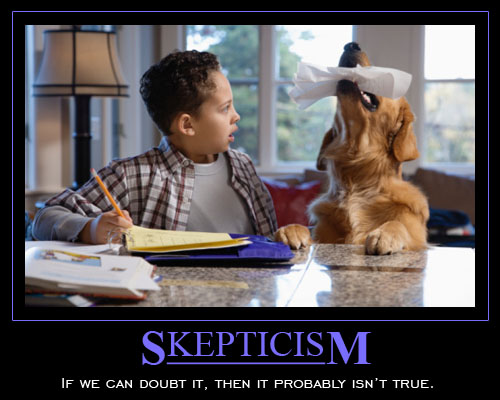
It seems that skeptics love other skeptics – up until the point such skeptics becomes skeptical of something that other skeptics accept.

Massimo Pigliucci is a skeptic, philosopher (meaning he teaches philosophy), and blogger who occasionally has some interesting things to say, which is why I subscribe to his blog.  Massimo is apparently a fan of James Randi, the well-known debunker of all things mystical.  Today Massimo writes:

James “the Amazing” Randi is an icon of skepticism. The man has done more — over a span of several decades — to further the cause of critical thinking and to expose flimflammery of all sorts than arguably anyone else in the world, ever. That is why I was struck with incredulity and sadness yesterday when I read Randi’s latest take on global warming.

Massimo opines on why James Randi would write such an article (besides the obvious reason that Randi is simply applying his same skeptical eye to the AGW claims that he does to everything else). Randi makes some interesting observations, and Pigliucci tries his best to hand-wave them away.  Which ever side you’re on, or especially if you have no side, it’s interesting reading.

(“Skepticism” poster linked from Xenocrates)

Posted in Faith, Science & Doubt, Politics/Current Events, Uncategorized | Tagged , , , , , , | 10 Comments

Atheism: nothing new under the sun

Atheism

[About the motivational poster:  It’s a double-entendre.]

I think about atheism more than probably most people, perhaps because I have friends who are atheists.  I am interested in their motivations and thought processes. I also find some of the philosophical arguments for and against the existence of God somewhat intriguing, although I’m not one to hang my hat on any particular philosophical argument.  For that matter, I don’t think many people do – including many who say they do.  I suspect that on either side of the question, philosophical arguments are often merely comforting myths and bedtime stories, meant to put our minds to rest.  (Real faith, on the other hand, is something much deeper.)   For both of the above reasons, over the past few years I’ve read some of the top-selling atheist books (which I’ve reviewed here occasionally), and I’ve been subscribing to some of the better atheist blogs.

Overall, I’m quite disappointed in the state of modern atheism.

I had expected to find new and fresh thinking – after all, these are the self-proclaimed free-thinkers and intellectuals – but instead have found that there’s very little free-thinking or deep-thinking going on.  An exception would be someone like Bradley Monton, who is perhaps more of a free-thinker than most atheists prefer.  What I typically find are ad-hominems, straw-men (or straw-gods), false appeals to authority, question-begging, hand-waving, red herrings and a lot of bluster.  Much of the time it seems atheists are merely trying to prove to themselves that they haven’t missed something; at least that’s how it often comes across.

Frankly, I’m bored with it.  Real philosophy and theology are so much more interesting.  Unless atheism starts going outside the “why evangelical Christianity and modernism don’t mix” box, it’s pretty much a waste of time (I would tend to agree that they don’t mix, anyway).  Most “de-conversion” stories I’ve read seem to result from failed attempts to rationalize Christianity with modernism, which is in my opinion an exercise in futility.

I have a theory that if many of these deconverts had looked to a pre-modern faith – say, Eastern Orthodoxy, Lutheranism or even Anglicanism – they would not have deconverted.  From reading various deconversion “testimonies,” it seems that most issues – when they weren’t simply moral issues – had to do with disillusionment with a Christianity that wanted badly to fit within a rather small modernist box.  Exposure to a Christianity which disregards that box, or at least downplays its importance, may have actually opened their minds rather than closing them to anything spiritual. But, I could be wrong.  If people were highly committed modernists, which many atheists seem to be, perhaps that is barrier enough to any sort of religious influence.

But I digress.

Atheistic arguments that target modern, redacted versions of Christianity are typically uninspiring and unproductive.   Besides being bored with the repetitive atheistic responses, I have no desire to argue for a modernist version of Christianity.  So, you see, I find most of the discussions rather inane.  While some atheist blogs will do what they can to keep the dream alive, I probably won’t even bother to read or comment about them any longer (unless I run across anything out of the ordinary).  If someone says something remarkable, feel free to let me know.

In the meantime, I’ll continue studying and writing on more substantial issues, such as continuing my series examining the differences between Western and Eastern Christianity, as well as tossing in the occasional post on atheism, because sometimes I just can’t help myself.

Posted in Faith, Science & Doubt | Tagged , , , | 28 Comments

Exploring the Twain 3 – Hurdles to Studying Eastern Orthodoxy

My current series is Exploring the Twain, in which I offend (unintentionally) evangelicals, Roman Catholics and Eastern Orthodox alike.  I am, at this point, an equal opportunity offender. The intent of the series is to examine the differences between Eastern and Western Christianity.  My hypothesis is this: Western Christianity has been so impacted by philosophical forces – including but not limited to Neo-Platonism and Modernism – that the only way to examine it is in light of the Eastern Church, which purports to have preserved the original Apostolic Christianity without change.

So far I have looked mainly at the early history of the Western Church, with an emphasis on the Neo-Platonism and Manichaean influences of Augustine, who is still technically revered by the Eastern Church but is occasionally called a heretic.  Augustine, in my opinion, did indeed have some wacko ideas which has skewed Western Christianity, such as the concept of “original sin” and our inheriting Adam’s guilt. Luther corrected much of Augustinian thinking (not all), but Calvin took the rest of the church (what is now evangelicalism, even if you don’t consider yourself Calvinist) further down Augustine’s path.  More on that at a later time.

While all this was going on, the Eastern Orthodox Church was basically ignored by the West, and vice versa.  Most Augustinian writing was not even translated into Greek (the adopted language of the Eastern Church) and again, vice versa.   In looking at the development of the Eastern Church, I have been reading numerous articles and books, such as Berkhof’s The History of Christian Doctrines, Three Views of Eastern Orthodox and Evangelicalism, and Encountering the Mystery by Ecumenical Patriarch Bartholomew, the head of the collected Orthodox churches.

What I have found in my reading so far is that this is not necessarily an easy task.

Hurdles to understanding

Eastern Orthodoxy is not easy for the Western mind to apprehend, because, well, it’s Eastern.  Way Eastern.  Their commitment to apophatic theology – defining God and other things by what they are not – make comparing theologies an apples – oranges kind of thing.  And, they define words differently. Justification is not seen in the Roman law court sense, and grace is not Augustinian (“unmerited favor”) but rather refers to God’s “energies.”  Even “theology” is not the same; in Orthodoxy, theology is not the study of God or what we know about God, it is a gift of revelation.  As Bartholomew puts it, “It is not taught; rather, it is caught.”

It’s almost like speaking 2 different languages.  Which, I should add, explains much of the misunderstanding by the West.

I found it interesting that nearly everything I read that was critical of the Eastern Church was written by a Calvinist.  And, like most such critiques by Calvinists, they mostly pointed out where the Orthodox were wrong for not being Calvinists.  This, by the way, isn’t helpful – and I find myself siding with whoever isn’t Calvinist, simply for that reason.

I also found it interesting that those who attempt to bridge the Twain, such as Bradley Nassif and Timothy Ware, are occasionally criticized by other Eastern Orthodox folks for being too Westernized.  Besides the Augustinian gap, there is also a pre- and post-Enlightenment gap that many of the Orthodox really don’t seem to like to cross.  Consequently, reading Bartholomew’s book was often a challenge, as my Western-category questions were not getting answered. Instead, I occasionally felt like I was reading some book on Zen; the Eastern thought process is often that different.

My hypothesis

My hypothesis, which I mentioned at the outset of this post, seems to have, in part, failed.  Based on my reading to date, it seems that while the Eastern Church lays claim to the unchanged Apostolic Faith, they too have been impacted by Neo-Platonism.  While this is a fairly common charge, and one which is typically denied by the Orthodox, it does seem quite obvious and even seems more pronounced (although taking a different turn than Augustine’s).

My next post will deal with the Neo-Platonist influences in the Eastern Church.

In the meantime, here are some questions to consider:

  1. If you are an evangelical, how do you – or would you try to –  understand Eastern Orthodoxy?
  2. If you are Orthodox or familiar with the Eastern Church, what do you see are the major issues between East and West?

Posted in Church, Exploring the Twain | Tagged , , , , , , , | 7 Comments

Historical evidence for the Bethlehem census story

Weekend Fisher writes today concerning some historical evidence for the story – often written off as mere myth – that Jesus was born in Bethlehem as a result of a census.   Apparently, as no Roman documents exist from that period, that there is no record of such a census.  However, some interesting documents exist from the 2nd and early 3rd centuries that refer to such tax/census documents.  He writes:

Justin Martyr, attempting to persuade the Roman government to stop persecuting Christians, refers the Romans to their own tax registers to verify Jesus’ birth. After mentioning the prophecy of the Messiah’s birth in Bethlehem he continues:

Now there is a village in the land of the Jews, thirty-five stadia from Jerusalem, in which Jesus Christ was born, as you can ascertain also from the registers of the taxing made under Cyrenius, your first procurator in Judæa.– Justin Martyr, First Apology XXXIV (circa 150-155 A.D.)

Tertullian makes a similar reference approx. 50 years later, indicating that Jesus’ birth was recorded in the documents kept in the archives in Rome, essentially challenging doubters to go look it up.

Of course, naysayers will respond that these 2 could simply have been bluffing, although I doubt they could provide any proof that either Tertullian or Justin Martyr had a tendency to make stuff up.  Historically, these references – if related to nearly any other issue – would be given serious consideration.

At this point, it would seem that there is no reason whatsoever to doubt this portion of the story.  And, this provides another example of why it is important to pay attention to the writings of the early church.

Posted in Faith, Science & Doubt, Random Thoughts, Uncategorized | Tagged , , , , , | 1 Comment