New atheism, bad philosophy

If there’s one thing that distinguishes the so-called “New Atheists” from the old atheists, it’s that the New Atheists are notoriously bad at philosophy, something I’ve said before. Edward Feser writes on this topic,

Philosophers and theologians are constantly told that they need to “learn the science” before commenting on quantum mechanics, relativity, or Darwinism.  And rightly so.  Yet too many scientists refuse to “learn the philosophy” before pontificating on the subject.  The results are predictably sophomoric.  What an arrogant and clueless amateur like Hawking or Dawkins needs to hear before putting on his philosopher’s toga is this.  And if he doesn’t get the message, this.  Instead, the reaction from equally clueless editors, journalists, and “educated” general readers is: “Gee, he’s a scientist! He’s good at math and stuff.  He must know what he’s talking about!”  It really is no more intelligent than that.

The new atheists are, for the most part, scientists, or at least adherents to scientism, the thinking that science is the answer to everything. Sam Harris even claims that science is a proper foundation for morality.

Something else that I’ve pointed out before is that science, which is a great tool for studying the physical world, suffers from some philosophical problems, mostly stemming from the so-called Enlightenment. The Enlightenment turned man’s ability to reason into an object of worship, as well as doing some other things for which we are still suffering.

As an example of bad philosophy, the new atheists love to refer to David Hume’s thoughts on miracles, however they ignore his thinking on inductive reasoning and science. Hume argued, I think correctly, that conclusions of causality are inductively, not deductively, reasoned; and he went on to propose that such inductive reasoning is justified by its success (which begs the question, “how does one measure scientific success, unless we have already determined what the desired results are?”).

Hume also concluded, again I think rightly so, that such inductive conclusions are limited to past causes and effects; one cannot predict the future based on past evidence. Predictions about the future are based on faith that the past will repeat itself, not on any proof that A always results in B.

What this means is that just because A has caused B for the last 100 years doesn’t mean that A will cause B tomorrow. Science simply cannot tell us that for sure. If science is at all successful, past evidence of cause and effect should give us, at best, a probability for what could occur in the future. If a certain drug worked for these other folks, it should work for you. Maybe. However, science’s ability to replicate past results is now being challenged.

The Decline Effect

In December of 2010 Jonah Lehrer wrote an interesting article for the New Yorker discussing the so-called Decline Effect, which has been noted over the past few years. Basically, what is happening is that conclusions proven by past studies, to the extent they are considered scientific facts, are suddenly showing themselves to be not true. Drugs that worked 10 years ago show no sign of working today. He writes,

But now all sorts of well-established, multiply confirmed findings have started to look increasingly uncertain. It’s as if our facts were losing their truth: claims that have been enshrined in textbooks are suddenly unprovable. This phenomenon doesn’t yet have an official name, but it’s occurring across a wide range of fields, from psychology to ecology. In the field of medicine, the phenomenon seems extremely widespread, affecting not only antipsychotics but also therapies ranging from cardiac stents to Vitamin E and antidepressants: Davis has a forthcoming analysis demonstrating that the efficacy of antidepressants has gone down as much as threefold in recent decades.

Lehrer posits that some possible causes of this decline effect is the subjectivity of the scientists (tending to prove things they want to believe), and bias in scientific reporting. Of course, this doesn’t explain why scientists today who want to confirm past findings are suddenly unable to do so, or why the law of gravity doesn’t give predictable results.

How Firm a Foundation…

Regardless of the cause of this decline effect, the reality is that science, at least at the present time, is not able to establish sufficient causation to predict future results, or to even correctly establish past causation. Medical and pharmaceutical beliefs are suspect, as are some of the “facts” of physics.

So, while I still believe that scientific studies have value, it seems that the ability of science to serve as a foundation for morality or religion—or atheism—is quite suspect. The decline effect just re-emphasizes some of the philosophical issues of those who hold science in too high a regard, and who have put their faith in man’s ability to reason and be objective (neither of which can be reasonably shown to be exist). The New Atheism—holding itself out as the pinnacle of reason and objectivity—suffers from bad philosophy, and a resulting misplaced faith in science’s ability to give us answers.

Posted in Faith, Science & Doubt, Philosophy | Tagged , , , | 11 Comments

The Kingdom is for Children

I’ve mentioned before that one of my favorite hymns is Children of the Heavenly Father, by Karolina W. Sandell-Berg:

Children of the Heavenly Father
Safely in His bosom gather
Nestling bird nor star in heaven
Such a refuge e’er was given

This hymn—as it should—echoes a prevalent theme in the Gospels: Jesus (and Heaven) is for children. Sitting in the pew with all of the adults, in my clip-on tie and shiny black shoes, it was always reassuring to hear Jesus say things like, “Let the children come to me, and do not hinder them (Luke 18:16).”

The story goes like this: People were bringing their children to Jesus, so that he could bless them. However, the disciples, in their well-intentioned cluelessness, began turning them away. I understand this, I really do. Kids can certainly be a bother, especially when we’re being selfish. The disciples were doing nothing that many other adults have done.

From W.C. Fields’ famous “Go away kid, you bother me” to “children should be seen and not heard,” it’s easy for kids to get the notion that they are 2nd class citizens. The adults drink coffee and discus religion and politics, while the children make too much noise and need too much assistance. If we’re being truthful, we must admit that children are a lot of work and can be very distracting. I suspect that often, Sunday School programs are set up for this very reason—to keep children occupied elsewhere—not because there’s a true desire to teach them anything (if you’ve ever read through Sunday School curriculums, you’ll have to agree with me—there’s not a lot of real meat in there).

However, here’s Jesus, telling the disciples, “don’t you dare send these children away, for the Kingdom belongs to them.” Serious? The Kingdom of Heaven is for children? Furthermore, he says, that adults must become as children in order to even enter the Kingdom. Whoa! Jesus just turns the whole social order, as it involves children, upside-down.

Another story, found the three synoptic Gospels, tells of Jesus teaching about the Kingdom. He picks out a child from the crowd, and again says,

“Truly, I say to you, unless you turn and become like children, you will never enter the kingdom of heaven. Whoever humbles himself like this child, he is the greatest in the kingdom of heaven. Whoever receives one such child in my name receives me; but whoever causes one of these little ones who believe in me to sin, it would be better for him to have a great millstone fastened round his neck and to be drowned in the depth of the sea” (Matt. 18:1-6).

I get the idea that children don’t necessarily need to be converted; that is, they believe in Jesus easily, and they seem to a fast track into the Kingdom. It is the adults who need to be converted from their adult thinking and attitudes. Fancy doctrines and theology are fine; however, real theology appears to be one which says simply, “I believe in Jesus.”

The Kingdom belongs to such as these.

  1. What did you believe as a child?  Why?
  2. How does one who has “matured” become as a little child?
Posted in This I know | Tagged , , , | 2 Comments

So, what do you want from Christianity?

Here’s an interesting question: What do you want from Christianity?

A long time ago I heard someone describing becoming a Christian as an act of “enlightened self-interest,” where we are motivated by what we hope to get out of it rather than a commitment to serve God and others. Looking at the Gospels, it seems that Jesus never turned people away for wanting something from him; in fact, it was those who didn’t want anything from him that he turned away. Even Peter’s great statement of faith, “where else would we go? Only you have the words of life” (John 6:68), speaks of Peter’s need for these words of life. So, this enlightened self-interest does not appear to be a bad thing.

Considering this, plus the fact that Christianity has, at least for many people in the west, become a consumerist endeavor—one in which we pick churches and even religions on what we perceive we need—then the obvious question becomes, “what do you want from Christianity?”

In answering this question, we could go a number of different ways. However, reflecting on Paul’s letter to the Galatians, there are two primary responses: a life under the law, with a list of requirements to fulfill, or a life of freedom. Many people, for a number of different psychological and bad theological reasons, choose a life under the law. A relative few, it seems, choose a life of freedom.

Two Gates

In Matthew 7:13-14, Jesus says

“Enter through the narrow gate. For wide is the gate and broad is the road that leads to destruction, and many enter through it. But small is the gate and narrow the road that leads to life, and only a few find it.”

Almost never do you hear this verse taught in the larger context of what Jesus is saying in Matthew chapter 7. He starts off by saying, “Don’t judge others.” Then, he speaks of the Father giving his children good gifts, merely for the asking, and teaches them what we know as the Golden Rule: treat others like you’d like to be treated back “for this sums up the law.” Immediately following verses 13 & 14, Jesus talks about false prophets, and how to recognize them by their fruit.

It seems here that Jesus is trying to teach his disciples a different way from that of the law; we don’t get by working, we get by asking. Good trees naturally produce good fruit. Take the narrow road, not the widely traveled one.

Works, or grace?

I’ve always heard the explanation of the two paths as “choose holiness, not sin,” and yes, there’s something to be said for that, even though this does not seem to be Jesus’ emphasis here. Paul says we were set free not to sin, but to live in freedom, which is not to sin.

But, which gate leads to a life of works-righteousness, and which is the gateway to freedom and grace? Is it possible that we’ve confused our gates?

If Paul’s thinking accurately represents the Gospel as Jesus intended it (which I believe it does), then what leads to destruction is relying on ourselves, and what leads to live is receiving grace as a gift—which seems to follow Jesus’ line of thinking in the prior verses.

The Question

So, the question remains: What really do you want from Christianity, a life of self-reliance and works-righteousness, or a life of freedom that comes from grace?

Posted in Good News | Tagged , , , , , , | 2 Comments

What it means to be blessed

I grew up in a church who read from the Gospels each week (along with a passage from the Epistles, and the Old Testament). Sermons were sometimes based on the Epistles, but I seem to recall more coming from the Gospels. For one thing, the Gospels were stories, and even children could understand most of them. Secondly, I suspect that a lot of the impact came from the fact that the Gospels contained the words of Jesus, not simply words about Jesus.

I don’t recall any sermons having the message that as Christians, our lives would be a bed of roses. It’s actually hard to come up with this kind of belief if you actually read the Gospels. Jesus actually promises us quite a bit of trouble, when you come right down to it. And, as he lived as one of us for 30-plus years, and ended up being tortured and killed, I think he understood what he was talking about.

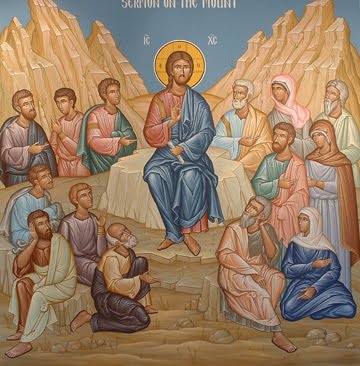
One of Jesus’ most famous sermons is the Sermon on the Mount, recorded in Matthew chapter 5. In a section known as the beatitudes, or the “blesseds,” Jesus says,

3 “Blessed are the poor in spirit, for theirs is the kingdom of heaven.
4 Blessed are those who mourn, for they will be comforted.
5 Blessed are the meek, for they will inherit the earth.
6 Blessed are those who hunger and thirst for righteousness, for they will be filled.
7 Blessed are the merciful, for they will be shown mercy.
8 Blessed are the pure in heart, for they will see God.
9 Blessed are the peacemakers, for they will be called children of God.
10 Blessed are those who are persecuted because of righteousness, for theirs is the kingdom of heaven.”

While some of the traits Jesus mentions are positive, such as being pure in heart, merciful and being a peacemaker, I don’t believe Jesus is saying that all of these are things to shoot for. Rather, he seems to be pointing out people who were personally suffering, or who were sacrificing their own good for the good of others. He did not meant that it is good to mourn or to be persecuted—in fact, the Lord’s Prayer teaches us to pray to be delivered from evil, which these things certainly are. While the beatitudes are promises of hope and the coming Kingdom, Jesus knew that even though the Kingdom of God was at hand (Matt. 3:2), for the present time there will be suffering.

The Kingdom of God—the rule of God—has been described as “already but not yet.” It is “at hand” or “within reach,” but yet Jesus asks us to pray that the Kingdom of God would come to “Earth as it is in Heaven.” Of course, when I was a child, this was beyond me, but yet I understood that God was in control in spite of suffering—and that at some future point, everything would be set right. Those who mourn would be comforted, and the poor in spirit would inherit Heaven. In other words, the future would more than compensate for the present.

As a parent, I understand this now, as I watched my children fall when learning to ride a bike and take medicine that was hard to swallow. It is a matter of perspective. We need to learn to see beyond the present into the future, trusting that from God’s point of view, it all works out to our good.

At times there is healing and prosperity, and at times there is suffering and mourning. God sent the Comforter because we would need comforting, and he sent Jesus to bring hope and salvation in the midst of it all. Those of us who know God understand this hope.

That’s what it really means to be blessed.

1.       When is the last time you heard a sermon from the Gospels?
2.       How have you experienced the comfort of the Holy Spirit?

Posted in This I know | Tagged , , | Leave a comment