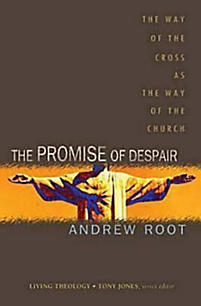
Book Review: The Promise of Despair

The Promise of Despair may not be the best title.  It probably won’t attract the same crowd that bought any of those “stories my kid made up about heaven” books, and some will assume it’s another “you’re not suffering enough for the Kingdom” teaching.

Then, there’s the “emergent village” logo on the back, which is another red flag for many people (including me).

I probably wouldn’t have given the book a second look if it weren’t for the fact that it was so highly recommended.

A Life-Changer

Contrary to any preconceptions I could have formed, The Promise of Despair has the potential to be the most life-changing book I’ve read in a long, long time.  I say potentially because I’ve only just finished it—a year or 2 down the road, and I can better assess what impact it is having. But, there are strong indications that it has that kind of potential, at least for me.  And, it’s a great book to read during Lent, as a primary focus is Luther’s theology of the Cross.

Death

One of the reasons this book is a potential life-changer for me is that this is a book about death.  Not about dealing with death, or grief, necessarily, but about death itself.  I have had a life-long fear of death, and have developed a pretty decent hatred of it.  I’ve seen it too many times as family and friends have been taken through disease, accidents, suicides, and simply oldness, and I live with death on a day to day basis.  So, it’s a subject close to my heart.

Root begins by discussing Nietzche’s assessment that modernism has essentially declared that God is dead, and the despair that results from our faith in progress and hope for the wrong future. It’s a brilliant assessment of modern culture, postmodern modern culture (postmodernism is just a branch of modernism),  and what has resulted to the church as it has attempted to cover over the reality of death and despair instead of dealing with it.  This is not your typical cultural critique; this is an analysis of a society’s failure to deal with death and it’s impact on Christian theology and practice.

Luther

The second reason for me is that I finally think I grasp Luther’s theology of the cross. I was raised in a Lutheran church that was not really all that Lutheran. I went through Confirmation classes and all, but I don’t think I ever saw a Book of Concord until I bought one a couple of years ago, and I had never heard the phrase “Law and Gospel” that I can recall.  But, I watched “Here I Stand” several times.

So, over the last few years I have tried to get a grasp on the basics of Lutheran theology that other Lutherans all seem to know, and this book clarified a number of things. Now I am more sure than ever that the Lutheran understanding of man and God is far superior (i.e. Biblical, or perhaps “correct”) to the Calvinism that permeates most evangelical theology.  In other words, the book is not a Lutheran book, but it uses some of Luther’s language to express Biblical truth about what death really is, and that—as the author puts it—”we do not suck,” but that we are all victims, as it were, of sin and death, which were defeated at the Cross.  Only by coming to grips with “the monster” do we get to see the true victory of the resurrection; if we don’t embrace death, we don’t get to embrace life.

As I read through this I thought of a fitting quote that I heard years ago that was attributed to Camus (though I have not been able to track it down): “Life begins when you come face to face with death and realize that anything is possible.”  I have understood this, but didn’t realize that this in fact was a kind of restatement of Luther’s doctrine of the Cross. Kind of.  Resurrection life is only possible through Christ taking on death head-on.

 The Problem with the book

The big problem I had with the last portion of the book was that the author seemed to lose his way a bit, trying to create practical applications.  He starts using questions his son asks as chapter themes, which is kind of cute, but didn’t really help make his point, causing him to stretch a bit too much to keep the analogy going.  This was especially true with the last chapter, “The Christian faith is a secret that must be kept.”  Here, he completely lost me. I never figured out why it was supposed to be a secret.  I don’t think he really knew how to end the book.

However, that doesn’t change the fact that the essence of the book is life-changing. As he explains in the book, all of Western culture has issues with death that keep us from really grasping the essence of the Cross and the power of the Gospel.

Conclusion

Buy the book, read the book. It’s that simple. Skip the intro if you want, and skim where you need to.  It’s short but powerful.


Posted in Reviews, Spiritual stuff | 3 Comments

Rediscovering the Banjo, Clawhammer Style

So, this is my 2nd post ever about banjos, even though they have been my primary hobby for the last 3 years. That’s restraint. If you like the banjo and want to learn a little history (very little), you might find this interesting.

Rediscovering the banjo for the first time

Even though I had owned a cheapo banjo about 30 years earlier, I knew so little about banjos when I started researching them about 3 years ago, I was shocked to find that the most popular style of banjo did not have the large resonator that the bluegrass guys played. And, I was also shocked to find that there was a common style of playing called clawhammer or frailing, that didn’t involve the use of picks. I was even more surprised to find that one of my all-time favorite banjo songs was in clawhammer style…


This, by the way, was the song that first got the banjo on Top-40 radio.

A little banjo history

Clawhammer style, where you strike the main strings with the back of the fingernail and pluck the 5th string with your thumb in a syncopated beat, has been around for hundreds of years. The 3-finger bluegrass style was more or less invented and popularized by Earl Scruggs. It was flashy and noisy (and new and exciting), so it caught on. The clawhammer style of playing actually dates back hundreds of years to Africa where 3- or 4-stringed instruments—always with a short drone string on top—were played in much the same fashion. This style of instrument and playing was brought over by African slaves, which explains the syncopation of the clawhammer playing style.

Sometime around 1830, the 5-stringed banjo was developed by a minstrel performer named Joel Walker Sweeney. By the civil war, 5-string banjos were getting to be popular; in fact, Stephen Foster’s famous song Oh, Susanna with it’s line “with a banjo on my knee” was published in 1848. An interesting historical sidenote is that in the early days of slavery, both African and Irish slaves were often housed together, where African rhythms were added to Irish folk tunes, giving us Appalachian or “old-time” fiddle and banjo music.

Banjo Mythbuster

buckbee copyMany people assume that when Sweeny added the 5th string to create the modern banjo, this means he added the short 5th string. However, that is not the case. As stated above, the banjo and its predecessors always had one short string. The 4-string Tenor banjo that became popular in the 20’s was a later invention—first appearing around 1910—that was developed to be strummed with a pick. The resonator was also developed to add volume so the banjo could be heard on early orchestral recordings, as guitars were, as this was pre-amplification, not loud enough.

By contrast (and for example), my oldest 5-string banjo is a Buckbee, dating back to around 1880-1890. (It is nearly identical to the banjo played by Taj Mahal in the movie Songcatcher.) The Buckbee Banjo Co. began manufacturing banjos during the Civil War and went out of business in 1896 or ’97.

One more tune…

Here’s another example of clawhammer playing: another old Stephen Foster song, Angeline The Baker, played on a banjo built by Doc Huff of Dallas, Oregon, who makes some of the most beautiful and unique banjos I’ve ever seen:

Okay, 2 more tunes. This is from the Honey Dewdrops, one of my favorite folk duos. Laura Wortman is a great example of a modern folk clawhammer banjoist.

Posted in Banjo | Leave a comment

Not All Banjo Music Is Created Equal

3banjosMy first banjo post

As my friends are all too aware, I’ve become something of a banjo addict since buying my first banjo not quite 3 years ago.  I play (old-time or clawhammer style), restore and collect banjos, and listen to a whole lot of banjo music of different genres. (Yes, there are distinct genres of banjo music.) So far, I have avoided posting anything about banjos on this blog, but have finally decided that it’s probably time to include the occasional post related to banjos and banjo music.

Surprise! I don’t like all kinds of banjo music

The more I listen to banjo music, the more opinionated I have become about the different banjo styles. While I have always thought I loved bluegrass music, I come to discover that I really don’t care for a lot of it, mainly due to the banjo playing. I recall something I once heard about the key to jazz music being knowing what notes not to play. With much of bluegrass, there is no such concept. To be honest, a lot of bluegrass banjo playing is just noise—too many notes unceremoniously crammed into too small of a space. When played with discretion, the banjo can add rhythm and drive, and even melody and counter-melody. The problem is, discretion seems to be in short supply with many bluegrass players.

Another complaint I have with bluegrass banjo is that many times the focus is on speed and dexterity. While I appreciate the abilities of folks like Béla Fleck or Jonny Mizzone (who’s like 10 years old), to me, I might as well be listening to a machine. There are a lot of fast, perfect notes, but it seems too clinical much of the time.

I do like some bluegrass banjo playing

I do really like some bluegrass players.  My favorite has to be Ron Block, who plays most often with Alison Krauss & Union Station. Block is a great player, and has a very good sense of melody and balance.  I appreciate his playing whether he’s playing on a pop song or a traditional bluegrass number. I liked Earl Scruggs, who invented the style. I’ve also liked a number of other players, like Doug Dillard, John Hartford, and of course John McEuen (of Nitty Gritty Dirt Band fame).  I’m also a big Steve Martin fan.

The infamous “G lick”

I’ve discovered one of the things that drives me nuts about a lot of bluegrass players, and that is the overuse of the infamous “G lick.”  It is probably the most recognizable lick in bluegrass banjo, as you’ll discover if you Google it. I’ve heard many bluegrass tunes where the G lick is used in nearly every phrase. It’s enough to drive you crazy, once you recognize it.  It’s one of the first things banjo players learn, and it seems like often it’s the only thing they’ve learned.  It belongs in “Foggy Mountain Breakdown,” but not in much else.

I was curious, so the other day I listened to 3 or 4 Alison Krause & Union Station albums. I didn’t hear the standard G Lick once. Ron seems to avoid it like the plague. There are times he does something similar, but he always varies it so there’s no obnoxious repetition. Here’s a recent example of what 3-finger playing should sound like (again, my opinion):

Here’s one more favorite recording of mine, which goes back many, many years:


Notice how the banjo approaches the song almost classically, with an awareness of each note being played (as well as each note not being played).  This kind of playing is what first attracted me to the banjo, not that racket that appears on 90% of the bluegrass I hear.

Good banjo, bad banjo

So, there’s good banjo, and then there’s bad banjo.  I like good banjo.

Posted in Banjo | 1 Comment

10 Things About My Opinions

I have a plethora of opinions

I think opinions are good. Without them, we’d be like the 2 guys in the old Army commercial:

“What do you want to do?”

“I dunno, what do you want to do?”

“I dunno… what do you want to do?”

Seriously, don’t you hate people with no opinions?  But at the same time, when you have opinions, you kind of like others to just accept yours. That kind of dynamic works for the short term, but in the end, no one grows. To grow, our opinions must be challenged and tested, and at least some of the time, they should change, because let’s face it, no one is right all of the time. In fact, most of us are not right most of the time—at least 100% right. We all have room to grow, and that’s what opinions are all about.

But, not everyone views opinions in the same way, and those who are not use to others having strong opinions can be offended by them. (And, it seems like it’s become America’s national pastime to be offended.)  Having an opinion has the necessary effect of suggesting (or stating outright) that someone else is wrong.

Considering that I tend to be fairly vocal about my opinion (although in a politish sort of way), I thought I would outline a few things about how I feel about opinions—and mine in particular—so I could refer people back here from time to time rather than explaining myself over and over.  So, here goes.

10 things to know about my opinions

  1. I have no shortage of opinions, and I don’t apologize for that.  I have opinions on all kinds of things, including politics, religion, philosophy, music, social issues, and banjos. If I don’t have an opinion about something, my presumed opinion is that it is not important.
  2. I expect you to have—or at least start to develop—opinions of your own.  If you don’t want to have opinions, feel free to borrow mine, but keep in mind that there are no express or implied warranties connected with my opinions.
  3. My opinions are usually resulting from a fair amount of thought, reading, analysis but at times are completely off the cuff. I won’t usually tell you which is which.  Caveat emptor.
  4. If I have an opinion, it’s because I think it’s right, and I will continue to think so until proven wrong.  Then, logically, I will consider my new opinion to be right, and my old one will be wrong.
  5. If my opinion differs from yours, my presumption is that you are wrong. Otherwise, you see, I would have your opinion…
  6. I believe I am wrong—at least partially—about everything I believe.  And I believe the same about you, perhaps even more so…
  7. I do change my opinions, sometimes quite drastically.  I have changed my opinion—often many times—about major theological issues, politics, etc.  I have even come to embrace the “Oxford comma.” However, my favorite color has always been blue.
  8. I do consider the opinions of others, even when I am arguing against them.  Opinions must be tested, and the best way to test them is through confrontation and challenge, in a friendly sort of way.
  9. Being proven wrong—i.e. changing opinions—is not failure, it’s growth.  And I will do my best to help you to grow.
  10. In the rare instance that I have no carefully crafted opinion on a topic, I reserve the right to make up an opinion on the spot and argue vehemently that you are wrong. Because that’s just who I am.


Posted in Philosophy, Random Thoughts | 1 Comment