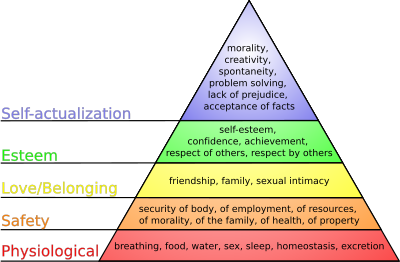
Ever since I first learned of it in the early 80’s, I’ve been fascinated by what is known as Maslow’s Hierarchy of Needs. In 1943, Abraham Maslow published his paper, A Theory of Human Motivation, in which he proposed that as humans resolved certain basic, universal needs, they went on to try to satisfy other, higher-level needs. In other words, some needs, such as position or the need to express oneself artistically, were not important until the more basic needs of food and shelter were addressed.
While there are studies that would show Maslow’s hierarchy to be incorrect (and perhaps not be a hierarchy at all), Maslow’s pyramid-shaped chart (like the “food group” chart) is encountered, it seems, in every field of study from the obvious psychology to education to marketing. It is certainly an interesting approach to look at how humans behave. I also wonder if Maslow’s theory shouldn’t be at least considered by churches in evaluating their philosophy of ministry and overall theology.
Before I develop this further, let’s take a look at Maslow’s hierarchy itself. The chart (I didn’t want to rip off anyone’s copyrighted chart… but it can be found here) starts with level one, the most basic, broad level, as physiological needs: food, water, sleep, and so on. This makes sense; if you don’t have access to enough food to survive the next week, why worry about that promotion? Level two is Safety, which is pretty self-explanatory; it does include safety of your stuff as well as personal safety.
Once these needs are met (or mostly met), we can move on to Love and Belonging, which includes family, friends, and community. Level Four is Esteem; while not having any value without any community to be esteemed by, once your belonging needs are met, esteem becomes (or can become) important. Finally, at the top of the pyramid we have Level Five, Self-Actualization. Here we have various forms of self-expression, including creative expression and having fun.
Now, with these categories in mind, take a look at yourself, your church, and your church’s ministries. Where do they fall in the pyramid? Personally, I’d have to say that most of our lives are spent in the penthouse, Level Five, as are the lives of the churches I’ve been involved in. Most of us don’t worry about having enough to eat. Jesus’ advice, “Do not be anxious…” has little meaning to us if we’re thinking about tomorrow’s lunch menu. Most of us know where we’ll be sleeping, which is not only climate-controlled, but relatively secure as well. We may become anxious about our retirement, but we’re not that concerned about tomorrow. We’re also not necessarily that lonely. If anything, many of us would give nearly anything for some simple peace and quiet, which is why we put away money so we can spend a week or two at “the cabin” away from everyone else.
Basically, America is a Level Five country. There are homeless, of course, but usually it’s their own fault (right?). The poor are often overweight, and many who live below poverty levels do so with a large screen TV in their living rooms. At least, this is our Level Five perception. Our churches do have programs for the needy (which I am not criticizing), and there are some individuals who put me to shame for their willingness to put their body where their mouth is (in America, money comes too cheap). However, when you look at American and American Christianity, we’re at Level Five.
Just take a walk into any Christian bookstore, and look at the largest sections. Missions, right? Discipleship? Mercy ministries? I am willing to bet that these are all fairly small, compact sections. The larger sections are for Christian Fiction (I keep thinking that should be an oxymoron…) and what is often called the “Christian Living” sections. Christian Living is a nice term for “how to live a more fulfilling life as a Level Five Christian.” We have books on money management, love & romance, and all kinds of “how to be happy” books. Happiness, by the way, seems largely to be a Level Five commodity. I’ve often said that those starving people in [insert 3rd world country here] probably aren’t thinking about how they weren’t affirmed by their fathers.
In Luke Chapter 8 Jesus tells the story of a man planting seeds. Some seed fell on good soil, some on bad. About the seed that fell among the thorns, he explained, “The seed that fell among thorns stands for those who hear, but as they go on their way they are choked by life’s worries, riches and pleasures, and they do not mature.” I find it interesting that one of the “advantages” of a Level Five Christianity is that we have the ability to choose our own thorns. And, it appears that much of the American Church is enabling this behavior. Are we pulling thorns, or planting them?
Jesus could have very well said, “It is harder for someone on the Self-Actualization level to enter the Kingdom of Heaven than for a camel to pass through the eye of a needle.” But, today we should be thankful, as we have 12-step groups, counselors and inner healing teams to help us deal with it.
Maslow’s Hierarchy may be incorrect, and I’m sure that reality is much more blended than the parfait-looking structure Maslow envisioned. However, I still think it’s an interesting tool to analyze our lives, and our ministry focus. Which brings me back to my post title: What’s your problem?