
Webber: The Divine Embrace 6 – Modern to Postmodern

In the opening paragraph to Chapter 4 of Robert Webber’s book, The Divine Embrace, Webber writes:

Spirituality has become situated in the narrative of the self. In this privatized spirituality evangelicals look to themselves for the confirmation of their spiritual condition. The self-focused spiritualities of the twentieth century have not emerged willy-nilly but are deeply rooted in the historical movements that separated spirituality from the vision of God… The problem of these dislocated spiritualities has been compounded by the current antihistorical, narcissistic, and pragmatic nature of evangelical Christianity.

In the 20th Century, three main forms of spirituality developed: legalism, intellectualism, and experientialism. The early century saw the rise of fundamentalism, which developed a legalistic mentality, a spirituality based on what a person does not do. These lists of don’ts is what separated one group from another, creating and us/them mentality. A doctrinal legalism also was developed, as fundamentalist groups defined their theology, adding extra, more defined articles of faith that one had to believe to be “orthodox.” For example, it was not good enough for the Bible to be inspired, you had to believe it was “inerrant.” As Webber states, legalism undermines the Gospel, and actually makes grace the enemy.

An intellectual spirituality also began to develop, grown out of a rationalistic, modern world-view. Spirituality became proof-oriented, a fact to be believed and argued. From this intellectual spirituality we saw the rise in apologetics. For liberals, who saw many of the Biblical stories as not fact-based or provable, they became myths whose purpose was to instruct about morality.

Then, romanticism and existentialism gave way to experientialism, where feeling God became another way of knowing God. Wesley’s experience, Webber posits, was universalized into the “defining mark of spirituality” and “feeling forgiven” became the goal of evangelism. Experientialism “elevates experience as the apologetic for faith.” Webber also suggests that the requirement to have a “personal relationship with Jesus” has led to a works-based mentality and an individualistic understanding to Christianity.

The later 20th century, with the cultural revolution of the 60’s, saw the development of antinomianism and narcissism, especially in worship, which also incorporated romanticism. Worship became about an emotional relationship which has to make us feel good in order to be true. With the influence of the “New Age” religions, it’s sometimes hard to tell Christianity from mysticism.

Another impact upon the church was the secular field of psychology; the thoughts of Freud, Carl Jung, and others led to the belief that we could be “healed” through self-discovery. The impact of this thinking on the contemporary church is obvious as we walk through any Christian bookstore, and see shelf after shelf of counseling and self-help books. Introspection and focus on the self has replaced meditation on the nature of God.

Finally, of course, we have the post-modern influence, which has rejected the Modernist concept of absolute truth. This is a rejection of the secular culture as well as the evangelical culture, both of which are rooted in modernism. For post-moderns, even experience is not prescriptive. Your story is not my story. I might be a Christian and believe that Jesus died for my sins, but it’s not necessarily right for everyone. Individualism is at an all time high. The “emerging” church seems to question everything, but accept eveything. Evangelical apologetics is essentially useless.

As I consider the many current forms of Christianity – most of them distinguished not by theology, but by the extra-Christian influences that they have adopted – it makes absolute sense that the result is post-modernism, or emergentism. As they say, something had to give. It seems that this cognitive dissonance of the modern church resulted in the letting go of truth (or what passed for it).

The answer to this mess, Webber believes, is that first the church must rediscover God’s story. It is here, that we go next.
Posted in Church, Reviews, Webber | 1 Comment

In Memory: Larry Norman, 4/8/47 – 2/24/08

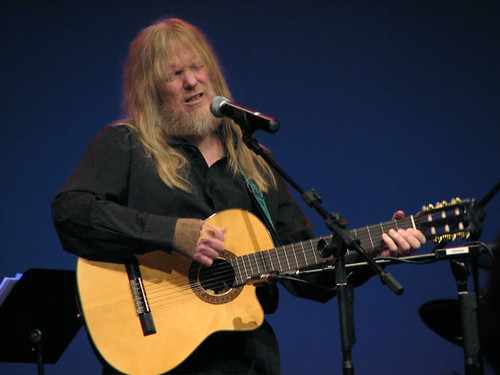
Larry Norman
Larry Norman in Concert, December 15, 2006 (photo by me)

I just heard that Larry Norman passed away yesterday morning at his home in Salem, Oregon of heart failure. He was 60 years old.

I wrote about Larry a little over a year ago, after I saw him in concert (where the photo was taken). He was very appreciative of the review, and posted a nice comment. Rather than blather any more now, I’ll just send you back to that earlier post.

Here’s a video of Larry doing one of my favorites, recorded in 2000:

[youtube=http://www.youtube.com/watch?v=ZWQKwIUErNc]

Posted in Random Thoughts | 3 Comments

Lutheran worship

Today I had the “day off” from teaching my Sunday School class, and decided that I’d visit our local Lutheran Church (an ELCA church). This was my first visit to a Lutheran church since the the branch I grew up in (LCA) merged with the more “liberal” branches of the church, and probably my first such visit in over 20 years (I think the last time was for a funeral). But, as I’ve been reconnecting with Lutheran theology over the past year, I thought it was time to actually experience a Lutheran worship service.

My first impression was that I perhaps had picked the wrong church to visit. I was a few minutes early, and the place was near empty. Rather than the organ music I was used to, there was a very sad little combo playing off to the side, with a drummer who really shouldn’t be a drummer. When the service began, there were perhaps 50 people there, with an average age of at least 70. I saw one child, and 3 other people who may have been in their 20’s. The Pastors were gone (a married couple), off to their daughter’s wedding. A woman pastor from a church downtown had come to fill in. And, rather than use the liturgy in the official hymnal, they were using parts of something called the “Bonnie Drewes Liturgy” with a couple of additional modifications. The “Confession of Sins” had us confessing that we hadn’t fed the poor and were not environmentally responsible. But, I decided to be patient and see what developed.

I was glad that I stayed.

The first part of the liturgy was focused on the reading of Scripture. It was read from “The Message,” and included selections from the Old Testament, the Gospels and the Epistles. After the sermon, there was more liturgy, including the collective recitation of the Lord’s Prayer and the Apostles’ Creed. Now, many probably will not understand this, but I couldn’t wait to say the Apostles’ Creed with these people; I was actually afraid they were going to skip it (I had a hard time following the schedule in the bulletin and things were out of order from what I remember from the old days). But, I should have known better – Lutherans would never skip the Apostles’ Creed.

It was the sermon, however, that had the biggest impact. It was a tremendous sermon; typical to Lutherans, it was about 10-15 minutes long, but she said more than most pastors get across in their self-indulgent 45-minute discourses. She spoke simply of the heart of Lutheran Worship, that no matter who we are outside of church, whether we are friends or enemies, we are sinners who need the saving grace of God. She spoke of baptism, and why the baptismal font is prominently displayed, to constantly remind us of the living water which washes us. And, she spoke of communion, that brings us all to the cross to receive forgiveness and grace.

It was then that I knew that I could take communion with these people. Now, I don’t take communion in the church I attend, because what they believe about it makes it either an empty act or an act of superstition. However, I understand what Lutherans believe, and the Pastor reminded me that in church we are all equal in our need for grace. Communion, you see, isn’t about the unity of our beliefs or lifestyles (there was at least one lesbian couple there); it’s about the unity we have as sinners who have been equally forgiven.

I understand Lutheran worship now, more than I ever did growing up. It probably helps that I understand what is so lacking in much of evangelical theology and worship; coming back, I see the depth in the apparent simplicity. It’s not empty ritual, it is the enactment of the story of God, of creation, incarnation, and re-creation, and of the reality of God’s kingdom, on Earth as it is in Heaven.

I need to do this more often.

Posted in Church | 8 Comments

Webber: The Divine Embrace 5 – Putting it together

Lately I’ve been writing about Robert Webber’s final book, The Divine Embrace, which has been really helpful in putting together the thoughts that I’ve already been having about the state of American Evangelicalism. It’s really been a breath of fresh air, and has allowed me to finally shake off some of the unhelpful evangelical baggage that I’ve carried around. I’m sometimes tempted to feel that I’ve wasted a lot of time trapped in evangelicalism, but I am quick to remind myself that I am merely continuing my “walk around the elephant” that is God. I am now finding myself full circle, as it were, older, wiser, and more solidly appreciative of my Lutheran roots. My adventures in evangelicalism have given me a perspective that few have, and I am appreciative of that perspective.

Granted, there are areas of evangelicalism that I have never dallied in. As I surf the theological weblogs, I am encountering many mindsets and belief systems that I am glad I haven’t been a part of. I have tasted, perhaps, the better portion of evangelical thought; I am finding that there are areas of the elephant that one shouldn’t dawdle around. Of late, I have been reading and to some extent participating in a theology blog entitled Parchment and Pen, which began discussing “who is emerging?” and drifted into discussions trying to determine who is or isn’t orthodox. A few minutes there should be enough to see why Webber’s analysis is so important.

Throughout the first few chapters of the book, Webber traces the history of the church and how various heresies and philosophies impacted the church’s concept of spirituality (and theology). Before I talk about the next chapter dealing with the Modern period (1900-2000), it would seem that a brief recap would be in order.

It is Webber’s premise that for the early church, spirituality was not separate from theology, which was focused on God’s business of creation, incarnation and re-creation. First, the early heresies:

  • Gnosticism – taught a dualistic deity, a “good god” and a “bad god,” as well as a dualistic view that the physical was bad, and the spiritual was good. Through esoteric knowledge, the human spirit could be set free from the confines of the physical.
  • Arianism – denied the incarnation of Jesus, saying that Jesus was not equal to God, but was created). As I understand it, this grew from a dualistic belief that God could not have become a physical man.
  • Pelagianism – a 4th Century heresy, teaching that man through his own will could live a sinless life, or add to his spiritual achievements by doing good works. Augustine refuted this by saying that man’s free will only leads him to sin.

Non-Christian philosophies which have impacted the church include:

  • Platonic Dualism – saw the material world as separate and inferior to the spiritual world. God moved from subject (who reached out to man) to object (someone for us to reach out to).
  • Mysticism – in the late medieval period, the focus of contemplation moved from the purposes of God to man’s experience. Spirituality became separated from theology and became a “discipline.”
  • Rationalism – borrowing from Descartes, human reason became authoritative. Thinking became based on the separation from subject (“I”) and object (“it”); in other words, everything was studied “objectively.” Knowledge became preoccupied with facts, considered value-free. Anything not “objective” – such as religion – became opinion, rather than fact. As a result, theology also became rationalistic, leading to apologetics and systematic theologies. Spirituality became “right belief.” Sanctification was separated from justification and became works-oriented.
  • Romanticism – a rejection of rationalism, romanticism called for an intuitive, inner experience and sought for a more holistic, organic approach to spirituality. Knowing was through the imagination, the senses and the human will. Pietism and revivalism focused on personal experience and a human-willed conversion and “holiness.” The focus on God’s will and Christ’s experience became replaced with a focus on man’s will and experience. Spirituality originated with the self.

Now that we see the evolution of Christian thought (due to the influence of these secular philosophies) from an emphasis on God’s work to an emphasis on our work combined with a complete split of mind and emotion, the church of the 20th and 21st Centuries begins to make a bit more sense. However, explaining it does not justify it.

Next, from Modern to Emerging.

Posted in Church, Reviews, Webber | 2 Comments